Why Most Job Descriptions Are Completely Wrong
Why Hiring Fails Before It Begins
Most hiring problems start long before the first candidate applies.
They begin with the job description.
Organisations spend time carefully writing lists of responsibilities, qualifications, and experience requirements. These descriptions are then used to advertise the role, screen candidates, and guide interview questions.
On the surface, this process appears structured and logical.
But there is a fundamental problem.
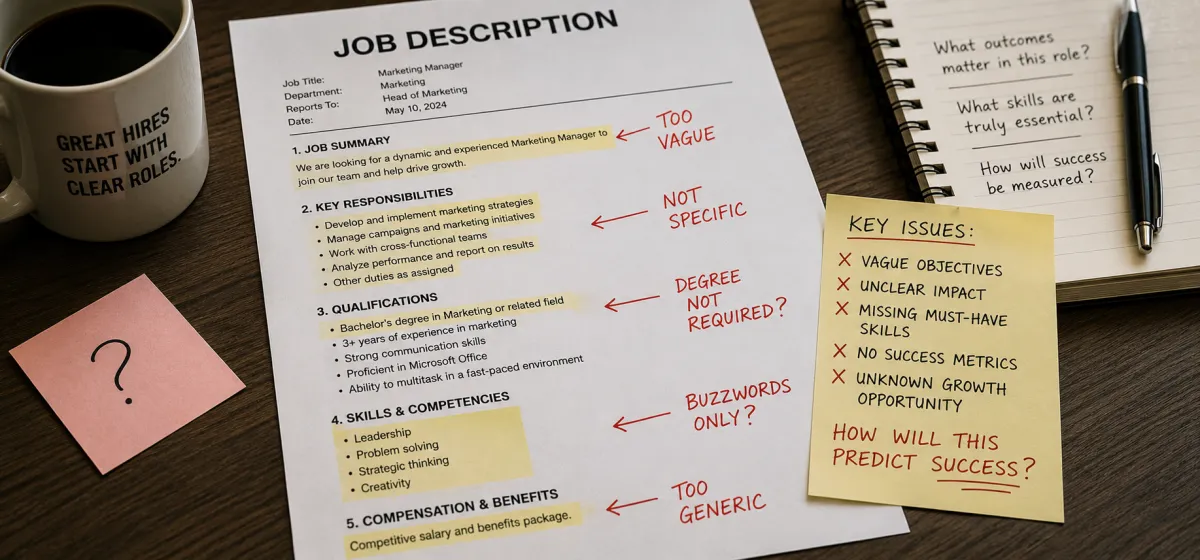
Most job descriptions do not describe what actually makes someone successful in the role. Instead, they describe the tasks associated with the job.
And tasks alone rarely determine performance.
The Task-Based Hiring Trap
A typical job description includes several familiar elements: a list of responsibilities, required qualifications, years of experience, industry exposure, and technical skills or tools.
These elements help define the operational aspects of the role. They explain what the job involves.
But they do not explain what kind of person will naturally thrive in the position.
Two candidates may have the same qualifications and technical experience, yet perform very differently once they begin the job. One may excel immediately. The other may struggle despite having a strong resume.
The difference often has little to do with tasks. It has everything to do with how the individual approaches the work itself.
The Invisible Drivers of Success
Every role contains underlying behavioural demands that are rarely written into job descriptions.
These hidden factors influence how work is actually performed day-to-day.
For example, some roles require rapid decision-making and comfort with uncertainty. Others demand careful analysis and structured thinking. Some positions involve constant interaction with customers, colleagues, or stakeholders. Others require long periods of independent problem-solving.
These characteristics shape the daily experience of the job far more than the list of responsibilities. Yet traditional job descriptions rarely mention them.
As a result, organisations often hire candidates whose skills match the tasks, but whose natural behavioural style conflicts with the demands of the role.

When Skills Match but Alignment Fails
This misalignment explains why many new hires struggle despite appearing perfectly qualified on paper.
Consider a highly analytical individual hired into a role that requires rapid decisions with incomplete information. Or a collaborative, relationship-driven professional placed into a position that demands long periods of independent work. Or someone who thrives on structured systems suddenly expected to operate in a fast-changing startup environment.
In each case, the candidate may possess the technical skills required for the job. But their natural working style may not align with the underlying demands of the role.
Over time, this misalignment leads to frustration, underperformance, and sometimes turnover. The organisation may conclude that the individual was not the right hire. In reality, the hiring process simply failed to define what the role truly required.
The Missing Blueprint in Hiring
What most organisations lack is a clear understanding of the behavioural blueprint of the role.
Beyond tasks and qualifications, every position requires certain behavioural tendencies for success. These may include pace of decision-making, tolerance for ambiguity, communication style, collaboration preferences, problem-solving orientation, and resilience under pressure.
Together, these factors form what we call an Ideal Job Profile.
The Ideal Job Profile describes not just what the job involves, but what type of individual is naturally suited to perform it well.
Without this understanding, hiring decisions are based largely on surface-level similarities between candidates and job descriptions. And surface-level similarity is rarely the best predictor of success.
The Evolution of Job Design
As organisations become more sophisticated in how they evaluate talent, the way roles are defined is beginning to change.
Forward-thinking companies are moving beyond traditional job descriptions and developing deeper insight into the behavioural demands of each role. Instead of simply listing responsibilities, they are asking more meaningful questions:
- What kind of thinking does this role require?
- How much autonomy does it demand?
- How quickly must decisions be made?
- What type of communication is most effective in this position?
- What environment will allow someone to thrive here?
Answering these questions transforms hiring from a process of matching resumes to job descriptions into a process of aligning people with roles where they can naturally perform at their best.
The Atumaphire Approach
At Atumaphire, we believe hiring should begin with understanding the true nature of the role.
Our platform uses behavioural analysis and role intelligence to help organisations define the Ideal Job Profile before candidates are even evaluated. This process identifies the underlying behavioural characteristics that consistently drive success in the role.
When candidates are assessed against this blueprint, hiring teams gain a far clearer view of which individuals are naturally aligned with the demands of the position.
The result is not simply a better shortlist. It is a hiring process that consistently identifies individuals who are more likely to thrive, perform, and remain engaged in the role.
Rethinking the Starting Point of Hiring
Most organisations assume that hiring begins when candidates start applying. In reality, hiring begins much earlier. It begins with how the role itself is defined.
When job descriptions focus only on tasks and qualifications, they provide an incomplete picture of what success actually looks like. But when organisations understand the behavioural blueprint of the role, they unlock the ability to identify candidates whose natural strengths align with the work.
And when that alignment exists, something powerful happens. People perform better. Teams collaborate more effectively. Organisations grow faster.
All because the hiring process started with a simple but often overlooked insight:
The most important thing to understand about a job is not what needs to be done. It is who is naturally built to do it well.