
Elon Musk Just Killed the Résumé
And Proved Why Hiring Needs to Change
Recently, Elon Musk made headlines with a simple but powerful decision:
He banned résumés and cover letters for hiring into his chip team.
Instead, he asked candidates to submit just three bullet points:
What are the toughest technical problems you’ve solved?
That’s it.
No polished CV.
No carefully written cover letter.
No keyword-stuffed experience summary.
Just proof of real work.
Why This Matters More Than It Seems
At first glance, this might feel like a bold or even unconventional move.
It’s not.
It’s actually a correction.
Because the traditional hiring system is built on signals that are no longer reliable:
Résumés show what someone says they’ve done
Cover letters show how well someone can present themselves
Interviews often reward confidence over capability
And now, with AI tools everywhere, these signals are even weaker:
Résumés can be perfectly optimized in seconds
Cover letters can be generated instantly
Candidates can rehearse or even outsource interview responses
So the question becomes:
What are you actually measuring anymore?
IMAGE
Musk’s Shift: From Claims → Evidence
What Elon Musk is doing is deceptively simple.
He’s removing narrative…
and replacing it with evidence.
Instead of asking: “Where have you worked?”
He’s asking: “What have you actually solved?”
Instead of: “How do you present yourself?”
He’s asking: “What have you produced under pressure?”
This is a fundamental shift.
Because past output is one of the strongest predictors of future performance.
But Here’s the Problem
While this approach works for someone like Musk…
It doesn’t scale easily.
Most companies:
Don’t know what questions to ask
Don’t know how to evaluate answers objectively
Still rely on gut feel in interviews
Struggle to compare candidates consistently
So even if they want to hire based on performance…
They fall back to: résumés, interviews, and guesswork.
This Is Exactly Why Atumaphire Exists
Atumaphire was built around a simple idea:
Hiring doesn’t fail because of sourcing.
It fails because of poor decision-making.
And decision-making fails when it’s based on weak signals.
So instead of improving résumés…
We replace them.

How Atumaphire Solves This (At Scale)
Where Musk asks for 3 bullet points…
Atumaphire turns that into a predictive system.
1. Performance-Based Questions
Candidates are asked:
What did you produce?
How was it measured?
How much did you achieve?
This forces real evidence, not storytelling.
2. Behavioural Profile Matching
We measure how a person naturally operates at work:
Do they drive outcomes or refine systems?
Are they structured or adaptive?
Do they build relationships or push results?
Then we match that against the Ideal Job Profile (IJP™).
3. Attitude & Work Ethic Signals
We assess how candidates think about:
accountability
ownership
pressure
standards
Because performance isn’t just skill - it’s mindset.
4. Role Predictability Score™
All of this feeds into one outcome:
A score that predicts how likely someone is to succeed in the role before you hire them.
The Bigger Shift Happening in Hiring
What Musk has done is not an outlier.
It’s a signal.
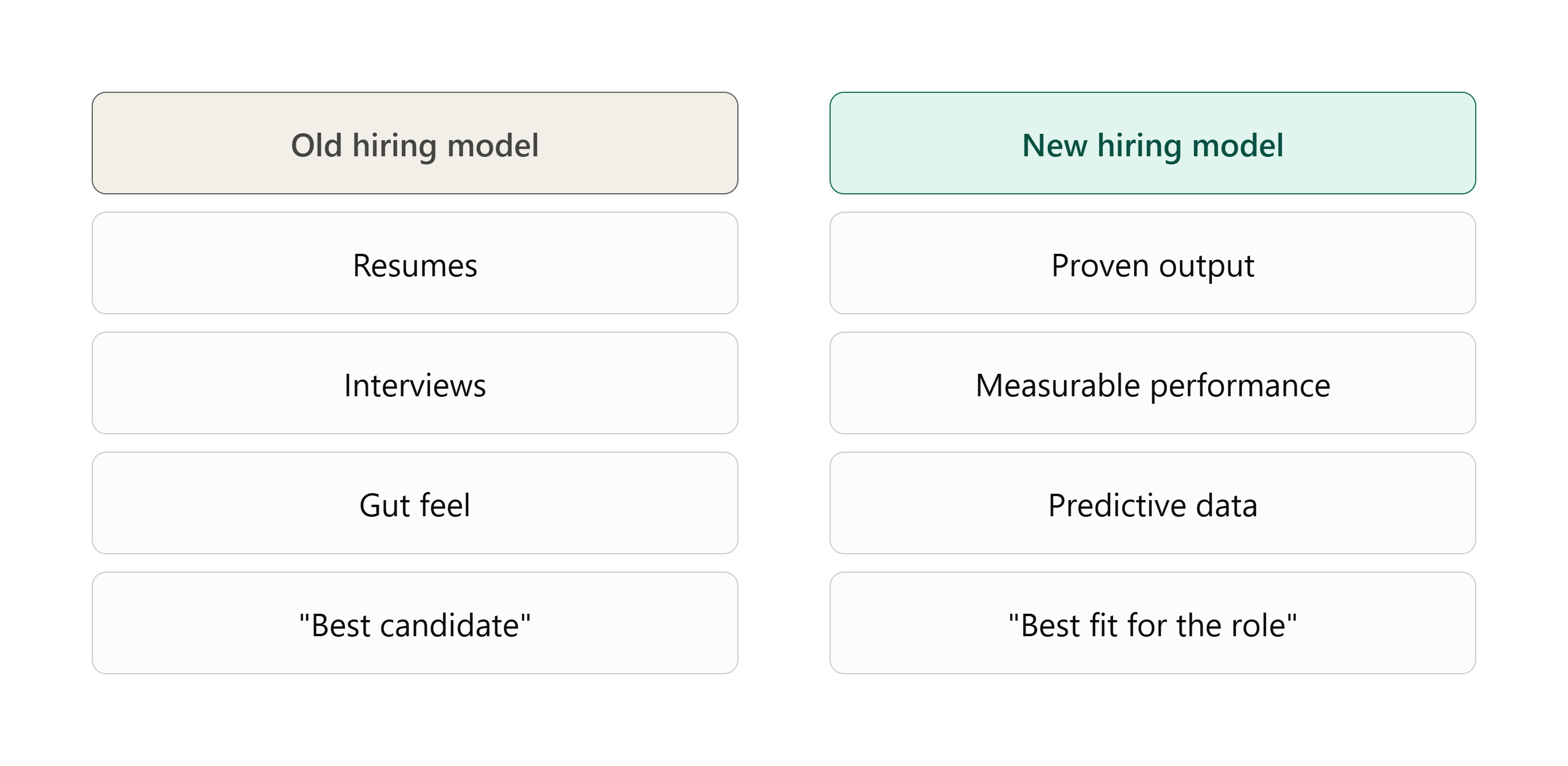
We are moving from:
The Real Question for Employers
You don’t need to copy Musk’s exact approach.
But you do need to answer this:
Are you still hiring based on how well someone can present themselves…
or based on what they can actually deliver?
Because those are not the same thing.
And they never have been.
Final Thought
Elon Musk didn’t reinvent hiring.
He stripped it back to what actually matters:
Evidence of performance.
Atumaphire simply takes that principle…
and turns it into a repeatable, scalable system.
The Future of Hiring
The companies that win in the next decade will not be the ones with the best employer brand…
They will be the ones who can predict performance before the hire is made.
That’s the shift.
That’s the category.
That’s Atumaphire.