
Candidates Are Not Rejecting AI in Hiring. They Are Rejecting Bad Hiring.
A recent article shared via MSN, titled “Nearly 4 in 10 job candidates have bailed on a hiring round because it required an AI interview”, should make every employer stop and think.
You can read the original article here: MSN article on candidates abandoning AI interview processes.
The headline is confronting. According to the article, around 38% of candidates have already withdrawn from a hiring process because it included an AI interview, and another 12% said they would drop out if required to complete one. The article draws on Greenhouse’s 2026 Candidate AI Interview Report, which found that 63% of job seekers have now experienced an AI interview. (Fortune)
That is not a small warning signal. That is the market pushing back.
But the wrong lesson would be to say, “Candidates hate AI.”
They do not.
The better lesson is this:
Candidates hate being processed by a machine when they do not understand the rules, cannot see the human judgement, and do not know whether anyone is actually considering them.
AI Has Entered Hiring Faster Than Trust Has Caught Up
The article explains that recruiters are using AI interviewers to “filter the flood” of applications. That pressure is real. Hiring teams are overwhelmed. Job ads attract hundreds, sometimes thousands, of applicants. Recruiters are under pressure to move faster, reduce cost, and identify better candidates from a noisy market. (Fortune)
So the attraction of AI is obvious.
But speed without trust creates damage.
Greenhouse’s own report says the first wave of AI interviews has failed on transparency, trust, and candidate experience. Most candidates are not clearly told upfront that AI will evaluate them. Many do not understand what is being measured. Some complete the process and never hear back. (PR Newswire)
That is not innovation. That is just a bad process with faster technology attached to it.
As the article puts it, some candidates feel they are “being processed rather than considered.” (Fortune)
That phrase matters because it gets to the emotional centre of the problem.
Hiring is not just a transaction. For the employer, it may be one vacancy among many. For the candidate, it can be their income, their confidence, their next career move, and their sense of dignity.
When AI is used badly, candidates do not feel assessed. They feel discarded.
The Problem Is Not AI. The Problem Is Removing the Human From the Process.
There is a huge difference between:
AI replacing human judgement; and
AI improving the quality of human judgement.
The first version damages trust.
The second version is where the future of hiring should go.
The article quotes Greenhouse’s Sharawn Tipton describing some AI-enabled hiring processes as an “arms race, not a hiring process.” (Fortune)
That is exactly the risk.
Candidates are using AI to mass-apply. Employers are using AI to mass-filter. Everyone is automating harder, but the quality of decision-making is not necessarily improving.
More applications.
More automation.
More rejection.
Less trust.
That is not a better hiring system. That is a faster broken one.
Candidates Want Better AI, Not Less AI
This is the part employers need to understand.
The Greenhouse report does not show that candidates simply want AI removed from hiring. In fact, only 19% of U.S. candidates said they wanted less AI involvement. Many candidates are open to AI when there is transparency, clear evaluation criteria, human oversight, and the option to request a human interview. (Greenhouse)
That is the real opportunity.
Candidates are not saying: “Never use AI.”
They are saying: “Tell me where AI is being used. Tell me what it is measuring. Make sure a human is accountable. Do not let a machine silently decide my future.”
That is a reasonable expectation.
And it is exactly where employers need to grow up.
Hiring Needs Intelligence, Not Dehumanisation
The future of hiring should not be about replacing recruiters, hiring managers, or interviews.
It should be about giving those humans better information before they make decisions.
That means AI should help employers answer questions like:
What does success in this role actually require?
What kind of person is likely to thrive in this environment?
What evidence should we look for before progressing a candidate?
Which claims in the candidate’s resume need to be verified?
What interview questions should we ask to test performance, values, and fit?
Where could this candidate succeed, and where could they struggle?
That is very different from asking AI to conduct an interview and quietly rank people behind the curtain.
Used properly, AI should make hiring more human, not less.
It should help hiring managers have better conversations.
It should help recruiters identify stronger evidence.
It should help candidates be assessed against clearer role requirements.
It should reduce guesswork, not replace accountability.
This Is Why Atumaphire Is Not an AI Interviewer
Atumaphire is being built around a different principle.
We do not believe the goal is to remove humans from hiring.
The goal is to stop humans from making high-stakes hiring decisions with weak information.
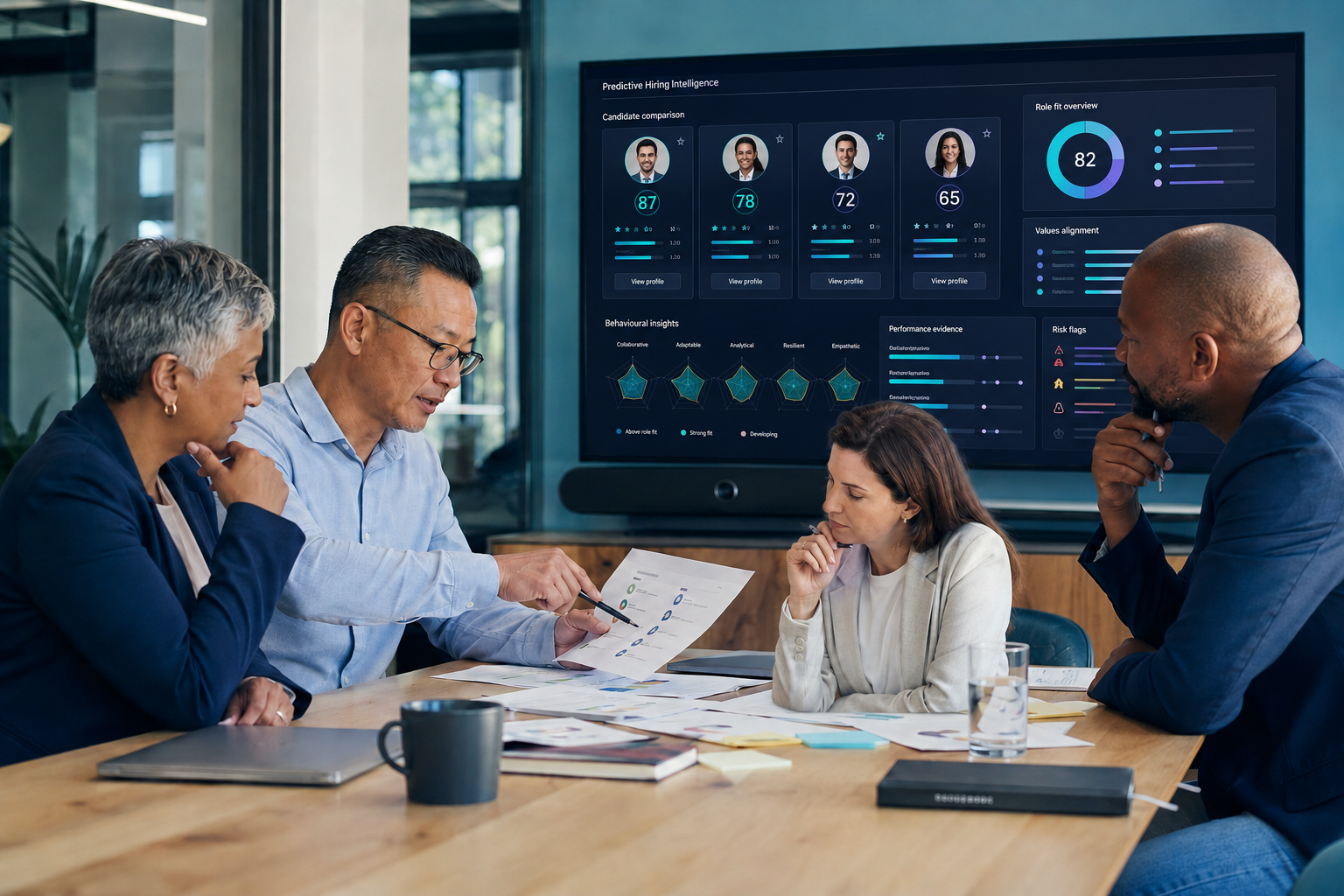
Atumaphire is a Predictive Hiring Intelligence™ platform. It helps employers define what success in a role really looks like, compare candidates against that role, and generate better evidence for interviews, reference checks, and final hiring decisions.
That distinction matters.
Atumaphire does not replace the recruiter.
It does not replace the hiring manager.
It does not make the final hiring decision.
It does not turn hiring into a black-box machine process.
Instead, it helps hiring teams understand:
candidate profile fit
past performance evidence
values alignment
potential risk areas
interview questions that need to be asked
reference checks that need to verify the candidate’s claims
The human still decides.
But now the human decides with better information.
The Employers Who Get This Right Will Win Trust
The companies that blindly automate hiring will damage their employer brand.
The companies that use AI transparently, carefully, and with human accountability will gain an advantage.
That is where the market is heading.
Candidates will not tolerate being pushed through robotic, unexplained hiring funnels. The best candidates often have options. If your process feels cold, confusing, or disrespectful, they will leave.
And when they leave, they may not just abandon the application.
They may remember your brand for the wrong reason.
The Bottom Line
AI in hiring is not going away.
But bad AI hiring should.
The lesson from this article is not that employers should avoid AI. The lesson is that employers need to use AI in a way that creates more clarity, more fairness, and better human decisions.
The future is not AI-led hiring.
The future is human-led hiring, powered by better intelligence.
That is the difference between processing candidates and genuinely considering them.
And it is the difference between using AI to make hiring faster, and using AI to make hiring better.
Want to see how Predictive Hiring Intelligence™ can help your team make better hiring decisions without replacing the human interview?
Apply for an Atumaphire pilot and see how the system helps you define success, assess candidate fit, and generate sharper interview evidence before you hire.