
The 22-Year Hiring Secret: From Guesswork to Predictive Intelligence
For more than two decades, a quiet advantage has existed inside a small circle of companies.
It wasn’t software. It wasn’t a database. And it definitely wasn’t something you could buy off the shelf.
It was a system.
A way of seeing people clearly before they were hired.
A way of predicting, not guessing, whether someone would succeed in a role.
And for 22 years, only a few hundred companies knew how to use it.
The result is one of the largest unmanaged risks on the balance sheet, hiding in plain sight.

The Hidden Truth About Hiring
Most hiring systems are built backwards.
They look at:
Experience
Qualifications
Interviews
Gut feel
All of which are after-the-fact indicators.
They tell you what someone has done, but not what they are naturally wired to do consistently, under pressure, in your specific role.
That’s why hiring fails.
Not because companies don’t try hard enough. But because they’re trying to predict the future using past fragments and subjective interpretation.
The System That Changed the Game
Over the last 22 years, a different approach was quietly refined.
Instead of asking: “Is this a good candidate?”
The system asked: “Is this the right human for this exact role, based on how they naturally operate and what they consistently produce?”
That shift changed everything.
Because the system didn’t rely on opinion.
It focused on three measurable dimensions:
1. What someone produces (Performance)
Not responsibilities. Not job titles. Actual output.
What did you produce?
How much did you produce?
Over what time period?
How did it compare to others?
This alone eliminated a huge percentage of hiring mistakes.
2. How someone shows up (Attitude)
Not what they say in interviews.
But how they respond to:
Pressure
Accountability
Ownership
Standards
Because two people with identical experience can behave very differently when things get hard.
3. How someone is wired (Profile)
The most overlooked, and most powerful, layer.
Every person has a natural way they:
Solve problems
Make decisions
Interact with others
Handle change
When this aligns with the role…
Performance becomes natural.
When it doesn’t…
Even great people struggle.
Why Only a Few Companies Had Access
This system wasn’t widely adopted for one simple reason:
It required discipline.
It required:
Structured questioning
Consistent measurement
Deep understanding of human behaviour
Time to analyse and compare candidates properly
Most companies didn’t have the capability, or patience, to execute it well.
So it remained in the hands of a small group of businesses who were willing to go deeper.
And those businesses gained a compounding advantage:
Better hires
Lower turnover
Higher performance teams
Faster growth
The Breakthrough: Automation
What used to take hours… Now takes minutes.
What required trained experts… Is now embedded into a system.
That system is Atumaphire’s Predictive Hiring Intelligence™.
It doesn’t replace your hiring process.
It becomes the decision layer inside it.
From Manual Method → Predictive System
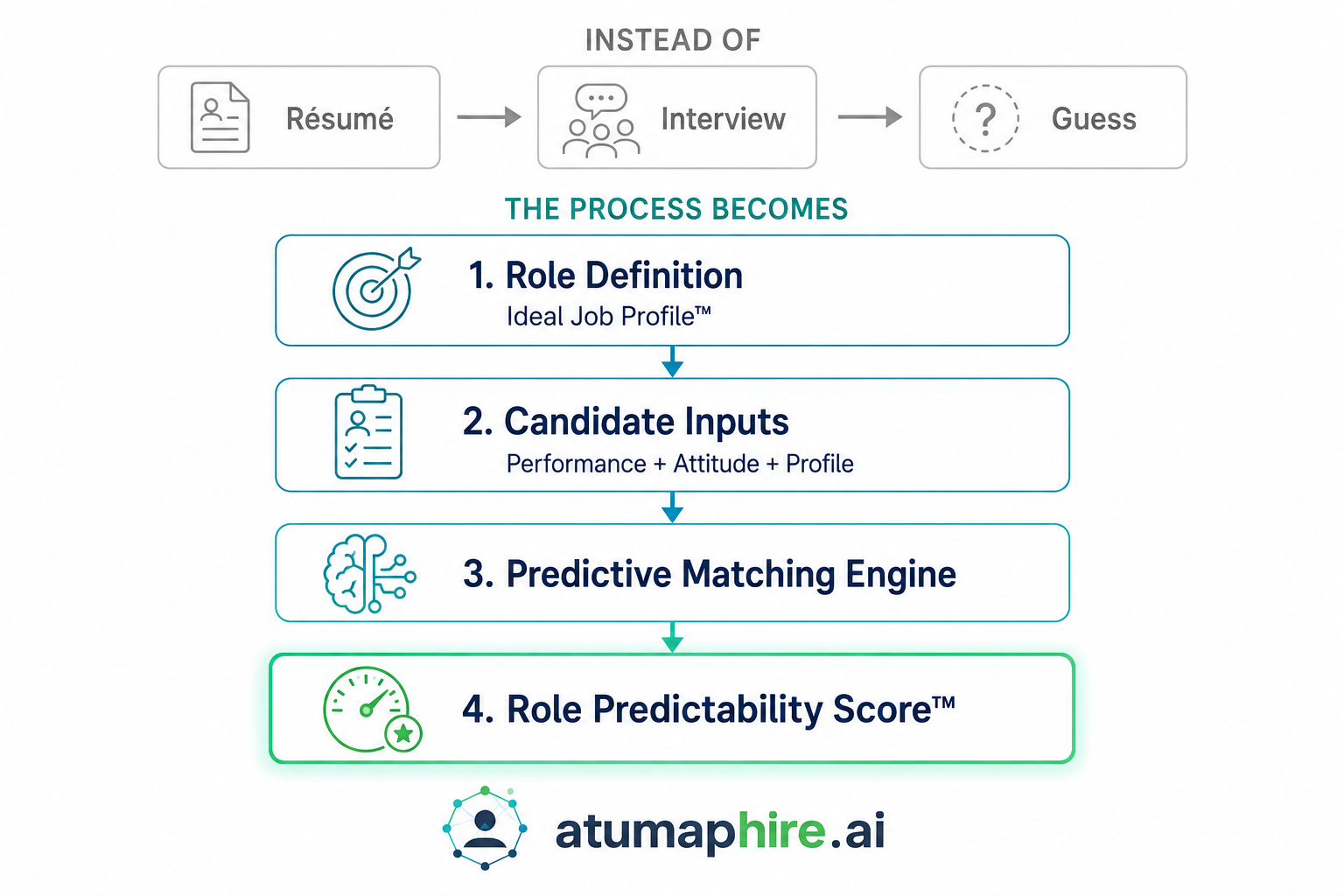
Now you’re not comparing candidates to each other.
You’re comparing each candidate to what success actually requires.
What This Means in Practice
Hiring shifts from:
“I think they’ll be good”
“They interviewed well”
“They’ve done something similar before”
To: “This person has an 81% likelihood of succeeding in this role based on measurable alignment.”
That’s a completely different level of decision-making.
The Real Impact
When companies apply this system consistently, three things happen:
1. Hiring becomes faster
Because you stop second-guessing decisions.
2. Teams perform better
Because people are operating in roles that match how they naturally work.
3. Cost of bad hires drops dramatically
Because you’re no longer relying on guesswork.
Why This Moment Matters
For 22 years, this system was limited by human execution.
Now, for the first time, it’s been translated into an automated intelligence layer.
That means:
No specialist required
No complex training
No manual analysis
Any company, any hiring manager, any recruiter…
Can now access what was once a hidden advantage.
The Bigger Shift
This isn’t just a better hiring tool.
It’s a shift in how companies think about people.
From: “Can they do the job?”
To: “Will they succeed here, predictably?”
Final Thought
The companies that quietly used this system for the past 22 years didn’t win because they had more candidates.
They won because they had better decisions.
Now that capability is no longer hidden.
The question is no longer: “Do you have access to it?”
The question is: “What happens when your competitors do?”