
The Science of Complementary Teams
Why the Strongest Teams Are Built on Differences
When leaders build teams, the instinct is often to bring together people who look similar on paper.
They share comparable experience. They have similar professional backgrounds. They approach work in familiar ways.
At first glance, this seems logical. Similar people often communicate easily, think along the same lines, and move quickly toward agreement.
But this approach contains a hidden flaw.
Teams built from similar personalities may feel comfortable, but they are rarely the most effective.
The strongest teams are not composed of people who think the same way. They are composed of individuals whose strengths complement one another.
The Comfort of Similarity
When teams share similar thinking styles, collaboration can appear effortless.
Discussions move smoothly. Ideas are accepted quickly. Conflict is minimal.
While this harmony may feel productive, it can hide deeper problems.
If everyone approaches challenges in the same way, important perspectives may never surface. Ideas may not be tested thoroughly. Potential risks may go unnoticed. Opportunities for innovation may be missed.
In other words, too much similarity creates blind spots.
Teams that lack diversity in thinking can become trapped in patterns where assumptions go unchallenged and creativity stagnates.
The Four Essential Team Strengths
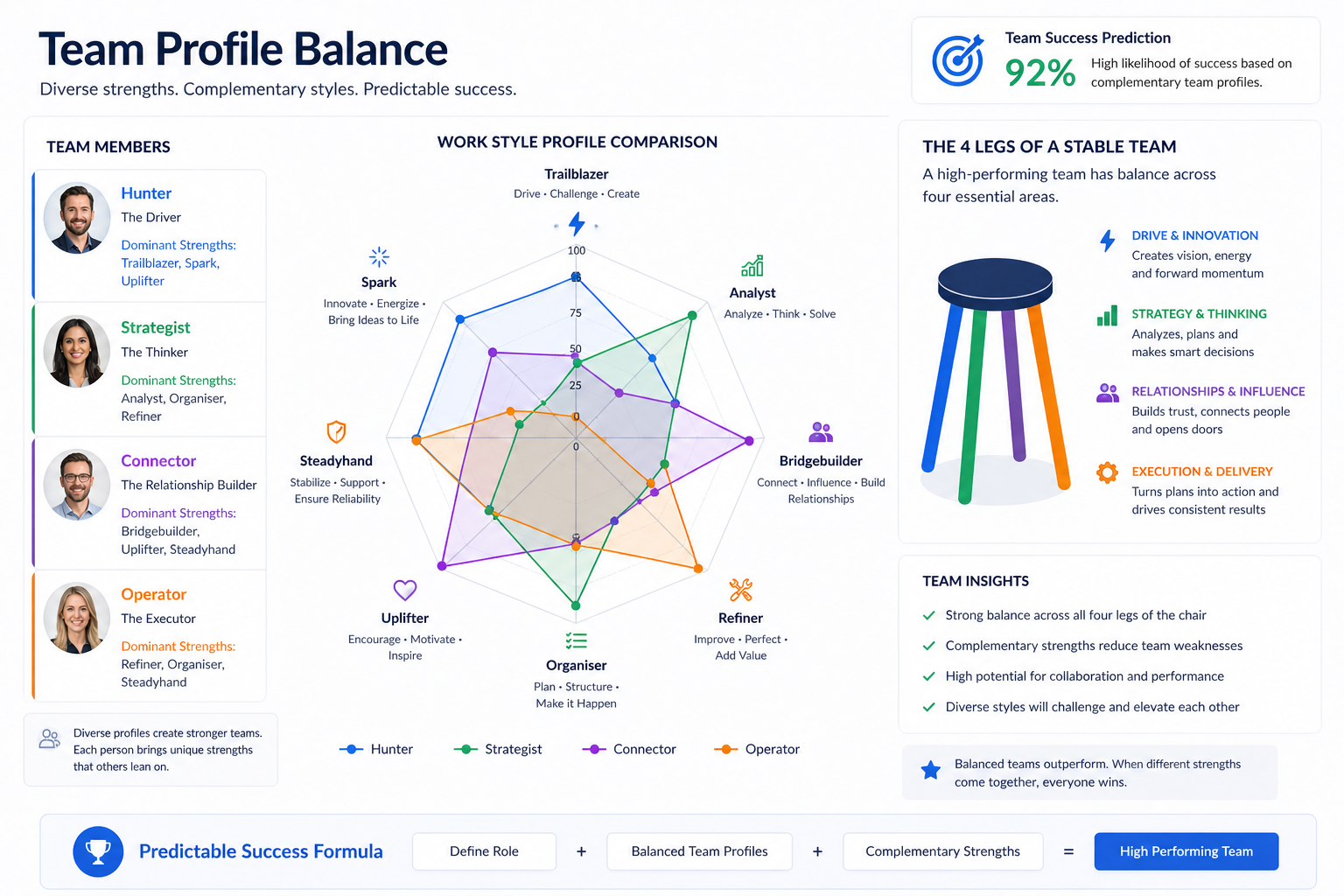
High-performing teams typically contain a mix of complementary roles that reflect different ways of thinking and working.
While every team is unique, many successful teams include four key types of contributors.
Visionary Thinkers
Visionaries are the idea generators. They look beyond current conditions and imagine what could be possible. They challenge conventional thinking, identify new opportunities, and inspire others to explore different directions. Without visionary thinkers, teams often struggle to innovate.
Strategic Planners
Strategic planners take ideas and transform them into structured plans. They analyse possibilities, evaluate risks, and design pathways that turn vision into achievable goals. While visionaries generate possibilities, strategists ensure those possibilities become realistic strategies.
Operational Executors
Executors focus on making things happen. They organise tasks, manage timelines, and ensure that plans are translated into concrete action. Without operational strength, even the best ideas remain unfinished concepts. Executors provide the discipline and momentum that moves teams forward.
Relationship Builders
Relationship builders strengthen communication and collaboration. They maintain team cohesion, support healthy dialogue, and help individuals work effectively together. They also play a critical role in connecting the team with customers, partners, and stakeholders. Without this relational strength, even technically capable teams can struggle with coordination and morale.
When Teams Become Unbalanced
Problems often arise when teams become dominated by one type of strength.
A team filled entirely with visionary thinkers may generate endless ideas but struggle to execute them. A group composed solely of executors may deliver efficiently but fail to innovate. A team dominated by planners may analyse endlessly without moving forward.
Similarly, teams with insufficient relational strength may experience communication breakdowns or internal tension.
Balance is what allows teams to move fluidly from idea generation to planning to execution while maintaining strong collaboration along the way.
The Power of Complementary Strengths
Complementary teams work because different strengths reinforce one another.
Visionaries spark new ideas. Strategists shape those ideas into clear direction. Executors bring them to life. Relationship builders ensure the team functions effectively throughout the process.
Each role contributes something unique.
When these strengths exist together, teams become far more resilient. They are better equipped to adapt to challenges, solve complex problems, and sustain long-term performance.
Understanding Profile Diversity
This balance of strengths is often referred to as profile diversity.
Profile diversity describes the variety of cognitive styles, behavioural tendencies, and working preferences within a team. Rather than trying to make everyone think the same way, organisations can intentionally build teams that include different perspectives and capabilities.
This diversity of profiles allows teams to approach problems from multiple angles. Ideas are challenged. Solutions are refined. Execution becomes stronger.
In essence, the diversity of thinking becomes a strategic advantage.
The Atumaphire Approach
At Atumaphire, we help organisations understand the behavioural profiles that shape how individuals contribute to teams.
Through profiling and behavioural analysis, leaders gain visibility into how people naturally think, collaborate, and approach challenges. This insight allows organisations to see where teams may be overloaded with similar profiles and where complementary strengths may be missing.
By designing teams with these insights in mind, leaders can create balanced groups that combine vision, strategy, execution, and collaboration. Instead of relying on chance, team effectiveness becomes something that can be designed deliberately.
Building Teams That Truly Perform
The strongest teams are not those where everyone thinks alike.
They are the teams where different perspectives come together to produce better ideas, smarter decisions, and stronger execution.
When organisations embrace complementary strengths and profile diversity, they unlock the full potential of collaboration. Ideas become richer. Decisions become wiser. Results become more consistent.
Because the real power of a team lies not in how similar its members are. It lies in how effectively their different strengths work together.