
The Leadership Blind Spot
The Leadership Challenge No One Talks About
Leadership is often seen as a matter of skill, experience, and character.
Organisations invest heavily in leadership training programs designed to help managers communicate better, make stronger decisions, and inspire their teams.
Yet despite these efforts, many leadership challenges persist.
Teams may struggle with engagement. Communication breakdowns occur. Decision-making slows down. Conflicts emerge between leaders and team members.
In many cases, organisations assume these problems stem from poor leadership ability.
But there is another explanation that is often overlooked.
Many leadership challenges arise not from poor leaders, but from misaligned leadership styles.
This is what we call the Leadership Blind Spot.
Every Leader Has a Natural Style
Just as individuals have natural working styles, leaders also have natural leadership tendencies.
Some leaders are highly analytical and prefer careful planning before taking action. Others are decisive and move quickly, making rapid decisions in fast-paced environments. Some leaders focus heavily on relationships and team cohesion. Others prioritise results, structure, and efficiency.
None of these styles are inherently right or wrong. They simply reflect how individuals naturally approach leadership.
The challenge arises when leaders assume their natural style is universally effective.
Leadership Style Is Context-Dependent
Leadership effectiveness is rarely determined by a single universal approach. Instead, it depends heavily on context.
Three factors in particular shape how effective a leadership style will be.
The Team
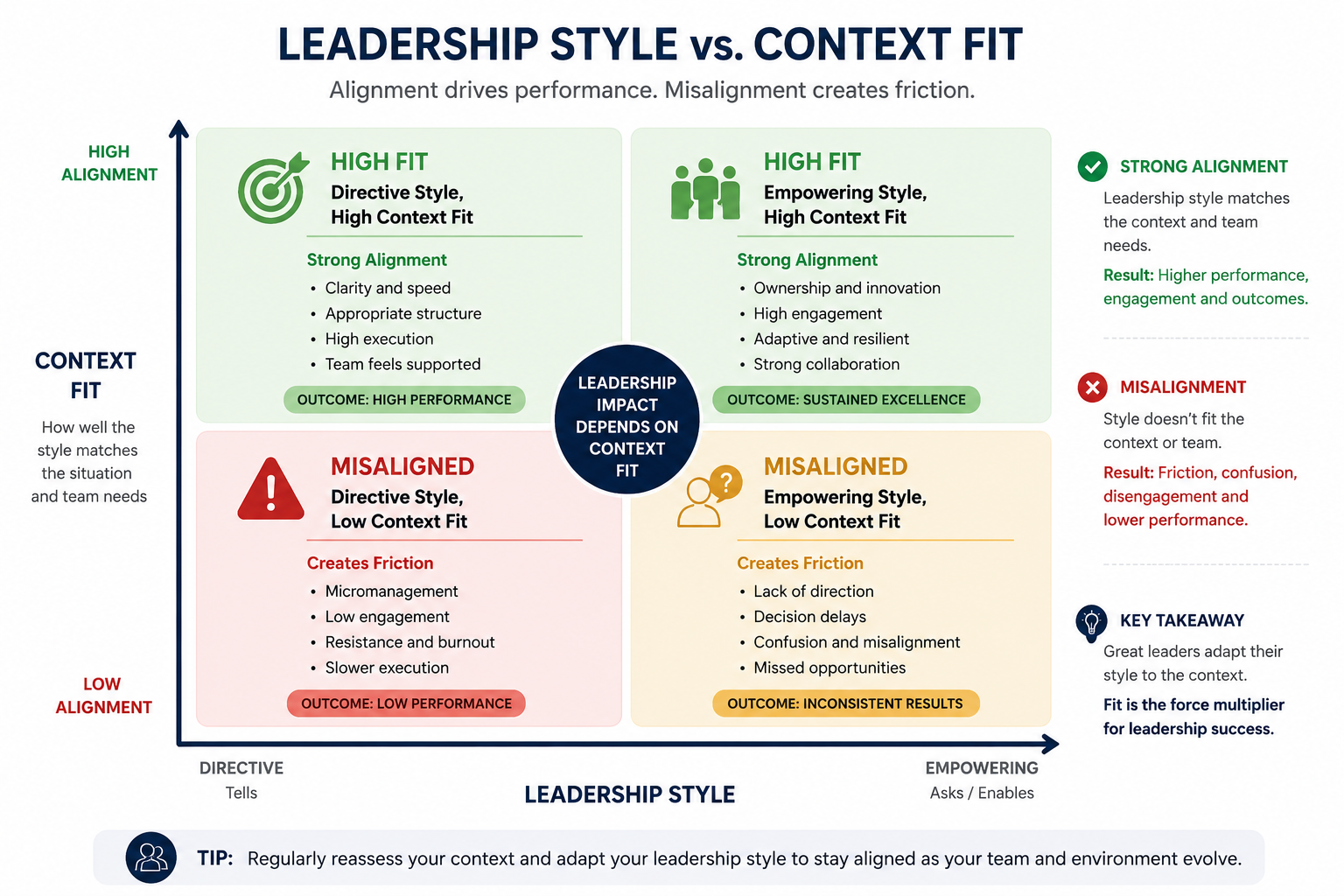
Different teams respond to leadership in different ways. A team of highly experienced professionals may thrive under a leader who provides autonomy and strategic direction. A less experienced team may require more structure, guidance, and coaching. If the leadership style does not match the needs of the team, tension can develop.
The Environment
Some environments are stable and predictable. Others are fast-moving and uncertain. A leader who thrives in structured environments may struggle in a chaotic startup setting. Likewise, a highly adaptable leader may find a rigid corporate environment frustrating. The environment shapes how leadership behaviours are perceived and whether they are effective.
The Challenges of the Role
Leadership demands also vary based on the nature of the role itself. Some roles require decisive action and rapid problem solving. Others demand careful coordination, diplomacy, and long-term planning. If a leader’s natural style conflicts with the challenges of the role, they may find themselves constantly pushing against their own instincts.
When Leadership Styles Clash
When leadership styles do not align with the team or environment, problems often emerge.
A highly directive leader may overwhelm a team that values autonomy. A collaborative leader may struggle to manage a team that requires firm decision-making. An analytical leader may delay decisions in environments that require speed.
In these situations, the leader may be seen as ineffective, even though their style may work exceptionally well in a different context.
Without understanding the dynamics at play, organisations often misinterpret these challenges as individual leadership failures.
The Importance of Self-Awareness
The first step in addressing the leadership blind spot is self-awareness.
Leaders who understand their natural tendencies are better equipped to recognise when their style may not align with the needs of their team.
This awareness allows leaders to adapt their behaviour intentionally rather than unconsciously relying on their default approach.
Instead of asking: “How should I lead?”
They begin asking: “What does this team need from me right now?”
This shift in perspective is critical for effective leadership.

The Atumaphire Approach
At Atumaphire, we help leaders gain a deeper understanding of their own behavioural profiles and leadership tendencies.
Through profiling and behavioural analysis, leaders can see how their natural style influences how they communicate, make decisions, and interact with their teams.
This insight provides a powerful advantage. Leaders begin to understand how their style affects team dynamics, where their natural strengths lie, and where they may need to adapt to support their team more effectively.
By understanding both their own profile and the profiles of their team members, leaders gain the ability to adjust their approach to suit different individuals and situations.
Leadership as Adaptive Alignment
The most effective leaders are not those who rigidly follow a single leadership model.
They are the leaders who understand how to adapt their style to fit the people and challenges around them.
They recognise when to provide direction and when to allow autonomy. They understand when a team needs structure and when it needs creativity. They adjust their communication style based on how different individuals think and work.
In other words, they lead with awareness and flexibility.
Seeing What Was Invisible
Many leadership challenges are not caused by poor leadership ability. They are caused by leaders operating without visibility into how their natural behavioural style interacts with the needs of their team.
Once this dynamic becomes visible, many problems become easier to understand and address.
Leaders gain clarity about their strengths and blind spots. Teams experience leadership that feels more aligned with how they work. And organisations develop leaders who are capable of adjusting their approach as situations evolve.
Because the true strength of leadership lies not in having a single style. It lies in understanding when and how to adapt that style to bring out the best in the people you lead.